leavened / bread / oven
Bread made with yogurt whey
Why whey changes the dough
It is not water under another name. Three differences decide the recipe:
| What | Effect | What to do |
|---|---|---|
| pH ~4.5 (lactic acid) | The gluten relaxes faster and weakens over long maturation | Strong flour, short rise, no 24 h in the fridge |
| Lactose | Baker’s yeast does not ferment it: it stays as residual sugar | The crust darkens much sooner, lower oven for the second phase |
| Residual calcium and protein | Softer crumb, keeps 3 to 4 days | Nothing to do, that one is the bonus |
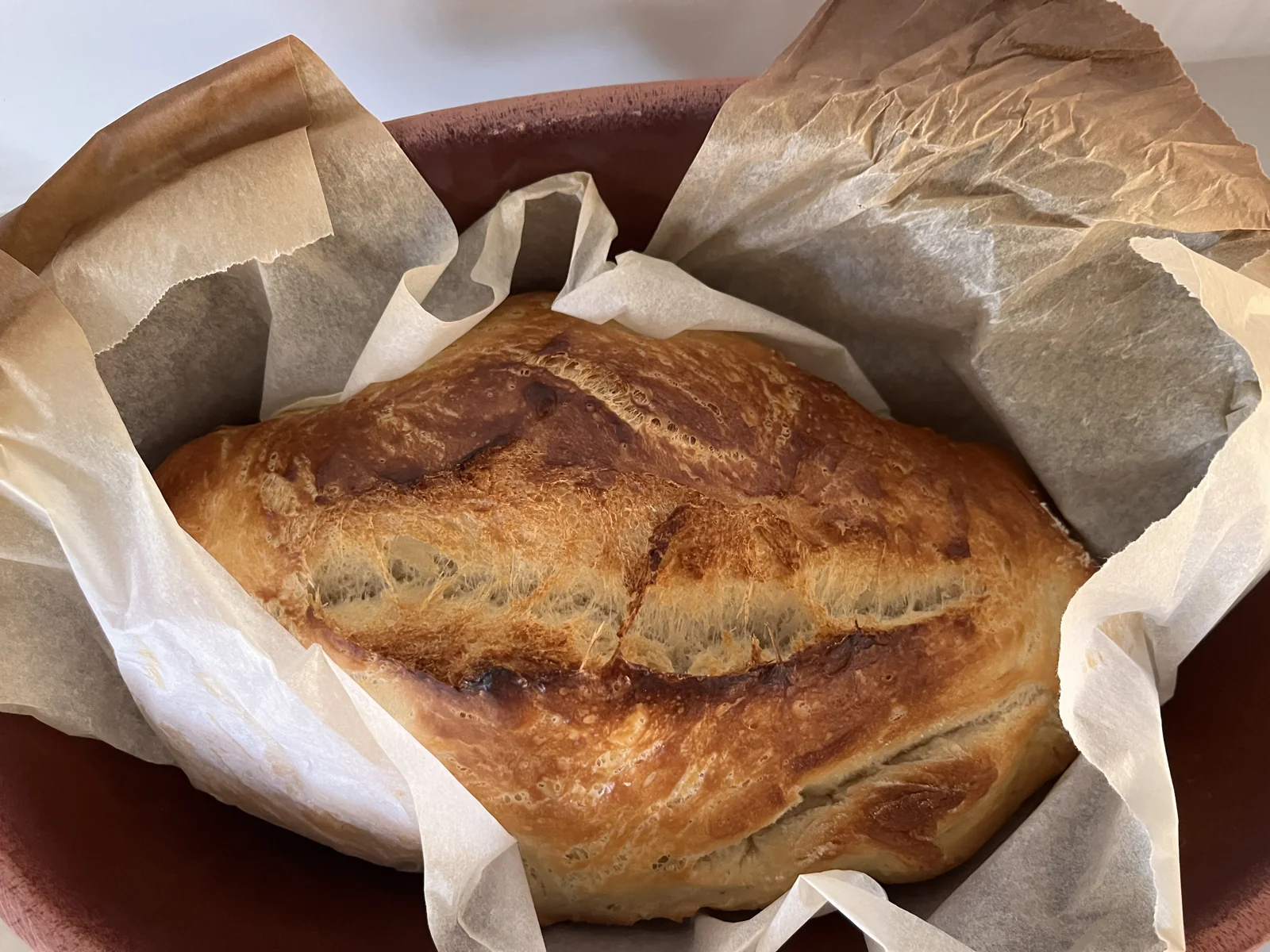
The result is a bread with a faintly lactic aftertaste, a close, soft crumb and a dark, thin crust. Closer to a buttermilk bread than to a rustic loaf.
Ingredients (1 loaf, about 800 g)
- 500 g flour: 350 g type 0 plus 150 g manitoba. You need the strength, see above
- 350 g yogurt whey, at room temperature (70% hydration)
- 10 g salt, no more: the whey already brings sodium
- 5 g fresh yeast, or 2 g dried
- 10 g honey or malt
- 15 g extra virgin olive oil, optional, for a softer crumb
If the whey does not reach 350 g, make up the rest with water. Below 250 g of whey the effect is lost, so you may as well make an ordinary bread.
Method
-
0:00 — Whey to temperature. Out of the fridge, bring it to 25-28 °C: a warm water bath, or 20 seconds in the microwave with a stir. Never above 40 °C, or the residual proteins coagulate and you get white flecks in the dough.
-
0:05 — Autolyse. Flours and whey in the mixer, or in a bowl with one hand, mixed until no dry flour is left. Cover, 20 minutes. The dough is rough and sticky, which is right.
-
0:25 — Kneading. Dissolve the yeast and the honey in two tablespoons of whey held back, pour them in, work 5 minutes. Add the salt, then the oil in a thread. Work another 5 minutes, until it comes together on the hook: the dough leaves the sides and a piece pulled off stretches without tearing.
-
0:40 — Bulk, 2 h at 22-24 °C. In an oiled, covered bowl. Two rounds of folds in the bowl at 0:40 and 1:10: wet your hand, take an edge from underneath, pull it up and fold it into the centre, four times, turning the bowl. Then leave it alone.
It should roughly double. With whey it goes faster than you expect: check at 1:40, do not go by the clock.
-
2:40 — Shaping. Turn it out onto a lightly floured surface, degas it only a little. Fold it into a parcel, then roll it up on itself and round it under a cupped palm until the surface is taut. Into a floured banneton or a bowl with a tea towel, seam up.
-
2:50 — Final proof, 50-70 min. Meanwhile the oven to 240 °C conventional with the cast iron pot and its lid inside, at least 45 minutes. The test: press with a finger, the dent comes back slowly and not all the way.
-
4:00 — Baking. Tip the loaf into the scorching pot, seam down, cut a cross with a blade, lid on.
- 20 min at 230 °C, covered
- 20-25 min at 205 °C, uncovered ← lower than usual, that is the lactose
- Take a look from minute 30: if it is already darkening too much, come down to 190 °C.
Done at 96-98 °C in the centre, or when the bottom sounds hollow.
- Cooling. On a rack, at least 1 hour before cutting. The crumb finishes setting outside the oven; cut warm it stays gummy.
Variations
Focaccia in a tin — in the focaccia, replace the 325 g of water with 325 g of whey and leave everything else. Bake at 210 °C instead of 220-240 °C: the oiled surface plus the lactose darken fast.
Tin loaf — same recipe with 30 g soft butter instead of the oil and 20 g sugar instead of the honey. A buttered 25 cm tin, proof to 1 cm from the rim, 35 to 40 min at 190 °C.
Pizza — it works, but only as a same-day direct dough. With a 24 to 48 hour cold maturation the acidity tears the gluten and the cornicione does not develop in the bake.
If something goes wrong
Slack dough that will not come together — the flour is too weak for the acidity. Raise the manitoba to 250 g, or drop to 65% hydration (325 g).
Nearly black crust, inside just right — normal the first time: it is the lactose, not the bake. Come down 15 °C in the uncovered phase.
Tastes too much of yogurt — the whey was old. Past 10 days in the fridge it gets distinctly more sour: use it within a week, or freeze it in cubes as soon as it is strained.
White flecks in the crumb — the whey was overheated at step 1.